How loud is snoring? What the decibels mean for your night
How loud is snoring? In one of the better measurements we have, researchers recorded 162 adult snorers overnight with a microphone about 65 cm above the head of the bed. The typical snore came in at around 45 decibels. Two thirds of the group went above 45 dB, and about one in seven went above 53 dB. For comparison, a whisper is about 30 dB and normal conversation is 60 to 70 dB.
So ordinary snoring sits between a whisper and someone talking. That sounds mild until you remember it goes on for hours, a few feet from someone who is trying to sleep. This guide covers what those numbers mean, why some people snore much louder than others, how to judge your own snoring without a sound meter, and when loudness is worth mentioning to a doctor. If you would rather just hear your own nights, Snorely is free to download and will show you the loud stretches tomorrow morning.
How loud is snoring in decibels?
The numbers above come from a study by Mudiaga Sowho and colleagues, published in the journal Sleep in 2020. The participants were self-reported snorers recruited from the community, and people with witnessed breathing pauses or severe obesity were screened out. In other words, this is everyday snoring, not a sleep clinic waiting room. The median snore was 45.4 dB(A), and the loudest group had a median of about 57 dB(A).
Roughly, the group split into three bands:
- Under 45 dB: about a third of snorers. Soft enough that a partner who falls asleep first may never notice.
- 45 to 53 dB: about half. The paper notes that sleep disruption commonly starts above 45 dB, so this is where a light sleeper starts to lose sleep.
- Over 53 dB: about one in seven. That is the level which research on road traffic noise has linked to heart and blood pressure problems in people exposed to it night after night, which is why the authors call loud snoring a form of noise pollution.
You will find much bigger figures online, 80 or 90 dB and sometimes over 100. Those usually come from microphones placed right by the mouth, from single peak snores rather than averages, or from record attempts. Distance matters a lot here: every time you double the distance from the source, the level drops by roughly 6 dB. A snore measured at a few centimetres and a snore measured from the next pillow are very different numbers.
What the numbers mean for the person next to you
Decibels are not linear. According to the NIDCD, part of the US National Institutes of Health, adding 10 dB makes a sound seem about twice as loud. So a 55 dB snorer sounds roughly twice as loud as a 45 dB one, even though the number only moved a little. The same source puts the risk of hearing damage at 85 dB and above for about eight hours, which ordinary snoring does not come near. The damage is to sleep, not ears.
Why is my snoring so loud?
Snoring is the sound of soft tissue in the throat vibrating as air squeezes past it. The narrower the gap and the harder the air has to push, the louder it gets. Most of what turns a soft snore into a loud one narrows that gap:
- Sleeping on your back. The tongue and soft palate fall backward. Many people are quiet on their side and loud on their back, and the side-sleeping guide covers how to stay there.
- Alcohol in the evening. It relaxes the throat muscles that keep the airway open. A drink or two before bed is one of the most common reasons for an unusually loud night, as the guide on alcohol and snoring explains.
- A blocked nose. Colds, allergies and dry air push you to breathe through your mouth, which makes the vibration worse.
- Being overtired. After a short night, sleep is deeper and the muscles are slacker.
- Weight and age. Both change the tissue around the airway over time.
The full list, with what you can do about each one, is in the seven common causes of snoring. If your snoring used to be quieter, read why snoring gets worse over time too, because the cause is usually something that changed.
How to tell how loud your own snoring is
You cannot hear yourself snore, so you need a witness or a recording. Both work, as long as you know what each one can and cannot tell you.
Ask the person who hears it, with a better question
"Was I loud?" gets a vague answer. Ask where they could still hear it. This rough four-step scale is more useful than any number:
- Only audible in the same bed when the room is quiet.
- Audible from across the room.
- Audible through a closed door.
- Audible from another room, or your partner has already moved out.
Steps one and two are common and mostly a nuisance. Steps three and four mean you are probably in the loud end of the range, and it is worth finding out why.
Record a night, and be careful with the numbers
A recording beats memory, but a phone is not a sound level meter. Its microphone is not calibrated, it adjusts its own sensitivity, and the reading changes a lot if the phone moves from the nightstand to the pillow. A free decibel app will give you a number, just not one you can compare to a study.
What a phone is good at is comparison. Put it in the same spot every night, about an arm's length from your head, and the difference between a quiet night and a loud one shows up clearly. Our guide on how to record snoring on iPhone covers the setup. Relative loudness, night against night, is what tells you whether a change helped.
The catch is the listening. A full night is seven or eight hours of audio, and finding the loud parts in Voice Memos means scrubbing through all of it.
Where Snorely fits
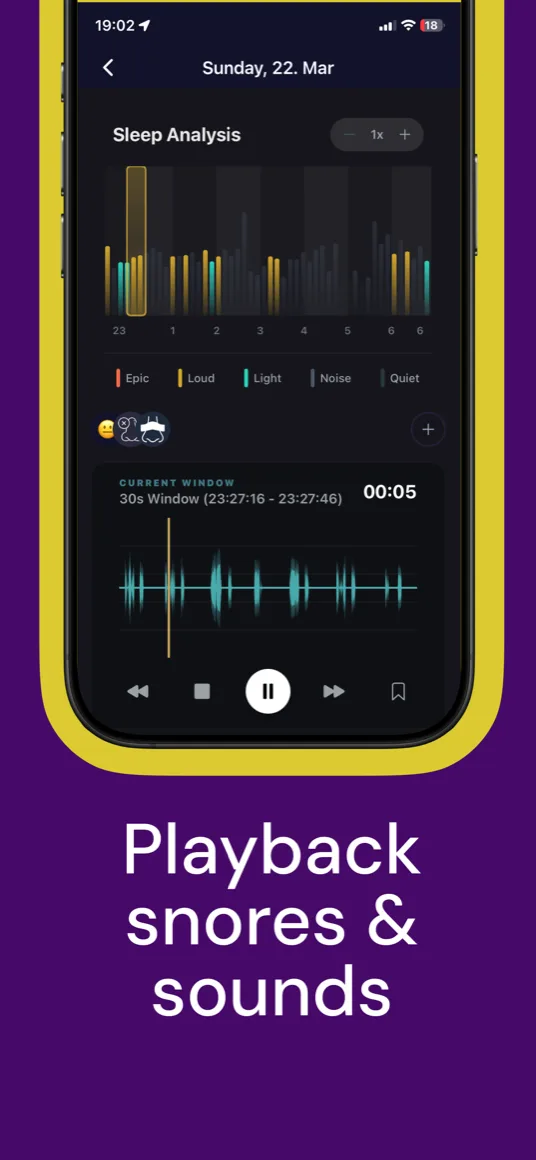
Snorely does the listening for you. It detects each snore on the phone, sorts every stretch of the night into bands (Quiet, Noise, Light, Loud and Epic), and draws them hour by hour so you can see when the loud parts happened. You get a Snore Score from 0 to 100 each morning and the clips themselves, so you can hear the loudest moment instead of taking a chart's word for it.
To be clear about the limits: those bands are relative to your own nights, not a decibel reading, and Snorely does not claim to be a sound level meter. For the question most people actually have, which is "was last night louder than usual, and why?", relative is what you need.
When loud snoring is worth a doctor's visit
Loudness on its own does not mean much medically. The 2020 study did find that louder and more frequent snoring predicted sleep apnea in its group, but most loud snorers are just loud. What makes loud snoring worth taking to a doctor is what comes with it:
- Snoring that stops suddenly, a silent pause, then a gasp or a choking sound.
- Breathing pauses that a partner has noticed.
- Feeling very sleepy during the day, or waking unrefreshed most mornings.
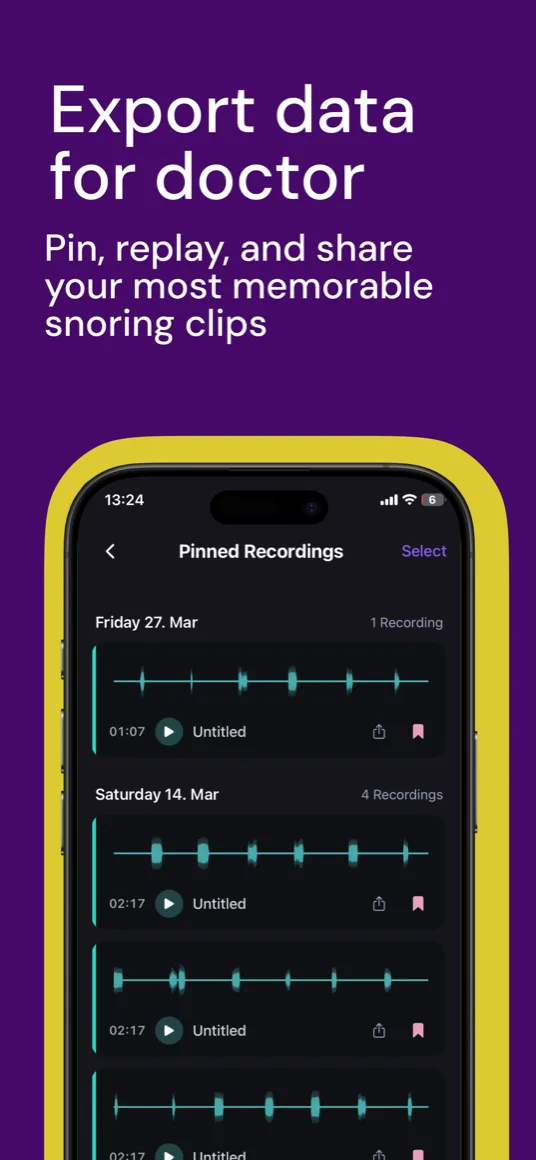
If that sounds familiar, read how to tell snoring from sleep apnea and book an appointment. A recording of the loud stretches helps the conversation. Snorely is a wellness and habit-tracking tool, not a medical device, and nothing on this page is a diagnosis.
Frequently asked questions
How many decibels is normal snoring?
In a 2020 study of 162 adult snorers, the typical snore measured about 45 dB(A) with the microphone 65 cm above the bed. That is louder than a whisper (around 30 dB) and quieter than normal conversation (60 to 70 dB). Six in seven people in the study stayed under 53 dB. Where yours sits depends on things you can often change, and our guide to why people snore covers the usual ones.
Is 60 dB snoring loud?
Yes. 60 dB is roughly the level of normal conversation, and it is above the median of even the loudest group in the 2020 study, which sat around 57 dB. Because every 10 dB sounds about twice as loud, a 60 dB snorer sounds more than twice as loud as a typical one. Position is often the cheapest fix, so start with the best sleeping position to stop snoring.
Can snoring damage your partner's hearing?
Very unlikely for ordinary snoring. Hearing damage is associated with sounds of 85 dB or more over about eight hours, and typical snoring measured from the bed sits far below that. The real cost for a partner is sleep: broken, lighter sleep night after night, which adds up. If that is the problem in your house, the remedies that actually work are the place to start, and a recording tells you whether they helped.
Is loud snoring a sign of sleep apnea?
It can be one sign, but not on its own. In the 2020 study, louder and more frequent snoring did predict sleep apnea, yet plenty of loud snorers do not have it. The signs that matter more are pauses in breathing, gasping or choking, and heavy daytime sleepiness. Our guide to snoring vs sleep apnea lists them in full. Snorely is a wellness app, not a medical device, and cannot diagnose sleep apnea.
Can my iPhone measure how loud I snore?
Only roughly. An iPhone microphone is not a calibrated sound level meter, and the number you get changes with distance and with where the phone sits. What a phone does well is compare: the same phone in the same spot, night after night, shows you clearly whether your snoring got louder or quieter. Our guide on recording your snoring with an iPhone covers where to put it.